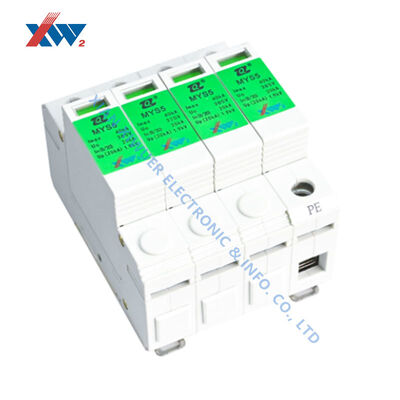
| Brand Name: | XIWUER |
| Model Number: | MYS5-385/20-4P(NS) |
| MOQ: | 100 |
| Price: | Negotiable |
| Payment Terms: | L/C,T/T |
| Supply Ability: | 3,000,000 pcs a year |
Modular Surge Protective Device (SPD) for TN-S Systems — "4+0" Circuit Configuration
This modular surge protective device is designed for TN-S power distribution systems using a "4+0" circuit configuration, providing reliable protection for all four conductors (L1, L2, L3, N) against transient overvoltages caused by lightning strikes or switching operations. Compliant with EN 61643-11 Class 2 and IEC 61643-11 Class II standards, it is suitable for installation at the second level of a coordinated surge protection system in residential, commercial, and industrial applications.
The device features an AC nominal voltage (UN) of 230V (50/60Hz) and a maximum continuous operating voltage (Uc) of 385V, ensuring stable operation under normal supply conditions. With a nominal discharge current (In) of 20kA and a maximum discharge current (Imax) of 40kA (8/20μs), it effectively handles significant surge events, while the low voltage protection level (Up ≤ 1.9kV) and fast response time (≤ 25ns) ensure sensitive downstream equipment is well protected.
Designed for practicality and durability, the SPD offers a wide operating temperature range of -40℃ to +70℃, a clear green/red status and fault indicator, and a compact single-port modular housing made of UL 94 V-0 thermoplastic material. Installation is quick and secure via a 35mm DIN rail according to EN 60715, with terminal capacities from 1.5mm² to 35mm² and M5 screw terminals tightened to 3.0Nm±10%. The IP20-rated enclosure is intended for indoor use.
An optional remote signaling function with a floating changeover contact (125VAC/1A or 30VDC/0.5A) allows status monitoring and integration into building management or alarm systems. Combining high surge handling capability, low protection levels, and easy modular installation, this SPD is an ideal solution for safeguarding TN-S electrical installations.
![]()
![]()